Impasto
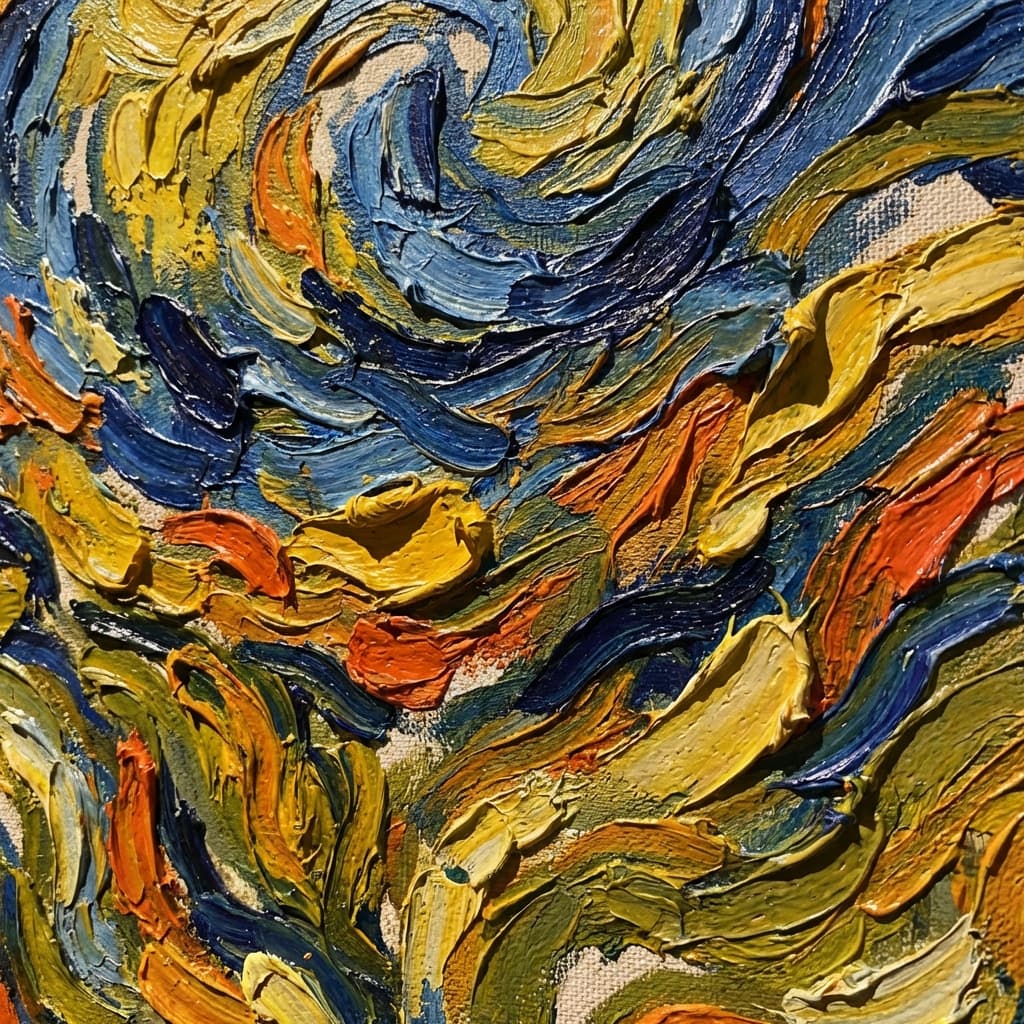
A painting technique in which paint is applied in thick, heavy layers or strokes, creating a textured surface where brushmarks and palette knife marks are clearly visible and form part of the work's expressive character.
What Is Impasto?
Impasto is an Italian term meaning "dough" or "mixture," and it describes the technique of applying paint so thickly that it stands up from the surface in visible ridges, peaks, and textures. Rather than creating a smooth, flat painted surface, the impasto technique makes the physical substance of the paint itself a prominent element of the artwork. Light catches the raised surfaces and casts tiny shadows in the recesses, giving impasto paintings a three-dimensional quality and a visual energy that cannot be reproduced in photographs.
The technique has a long history in Western painting. Rembrandt used impasto selectively in his later works, building up highlights with thick strokes of lead white that seem to glow with an inner light, while painting shadows thinly. This contrast between thick lights and thin darks became a hallmark of his mature style and influenced painters for centuries. In the nineteenth century, Vincent van Gogh made impasto central to his artistic identity, applying paint in thick, swirling strokes that convey the emotional intensity of his vision. His paintings of sunflowers, starry skies, and wheat fields are as much about the physical presence of the paint as they are about their subjects.
In the twentieth century, impasto became associated with a wide range of practices. The Abstract Expressionists, particularly Willem de Kooning and Joan Mitchell, used thick, gestural brushwork to convey energy and emotion. Frank Auerbach built up portraits and landscapes over months or years, creating surfaces sometimes several inches thick. Contemporary artists like Anselm Kiefer incorporate impasto along with other materials like straw, lead, and ash to create heavily textured surfaces that evoke landscape, history, and memory.
Why Does It Matter for Collectors?
Impasto paintings reward in-person viewing in a way that few other techniques can match. The textural richness that makes impasto compelling also makes it impossible to fully appreciate in reproduction, which means collectors who seek out these works in person often discover a dimension of beauty and power that images cannot convey. This quality gives original impasto paintings a particular advantage over prints and digital reproductions.
From a conservation perspective, thickly painted surfaces require specific care. Heavy impasto can be vulnerable to cracking if the underlying support is unstable or if the painting is subjected to physical shock. Oil paint applied in very thick layers can also take years to dry fully, and during this extended curing period, the surface may be more susceptible to damage. When collecting impasto works, ensure that the painting is properly supported and framed, and avoid hanging it in locations where it might be bumped or subjected to vibration.
Related Terms
Visual representation of Impasto