Romanticism
A late 18th to mid-19th century movement that emphasized emotion, individualism, and the sublime power of nature as a reaction against the rationalism of the Enlightenment and the order of Neoclassicism.
What Is Romanticism?
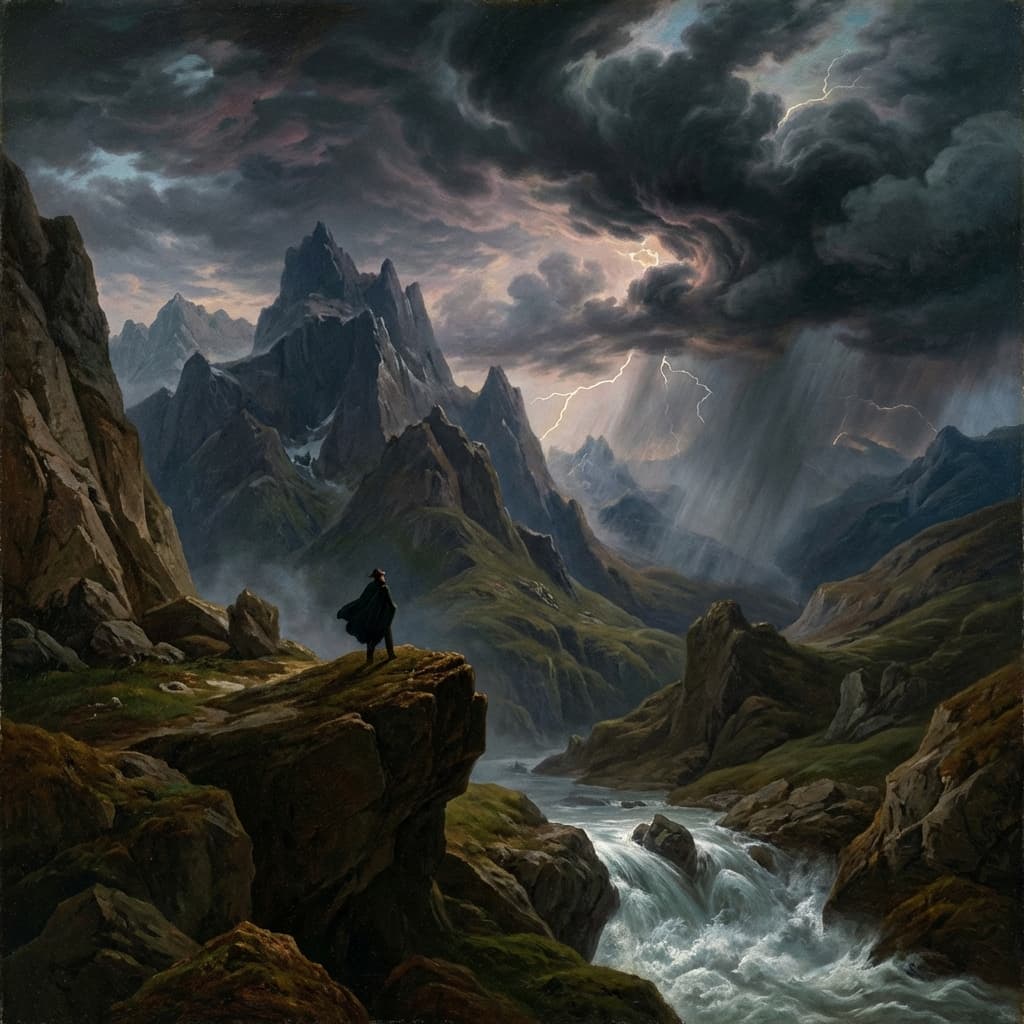
Romanticism was a broad cultural and artistic movement that swept across Europe and America from the late eighteenth century through the mid-nineteenth century. In painting, it championed emotion over reason, imagination over observation, and the individual artist's vision over adherence to classical rules. Romantic artists were drawn to dramatic subjects: storms, shipwrecks, ruins, wild landscapes, and scenes of intense human passion or suffering. The concept of the "sublime," the awe-inspiring experience of nature's overwhelming power, became a central theme.
In France, Eugene Delacroix led the Romantic revolt against the cool precision of Neoclassicism with paintings of explosive color and dramatic intensity. His "Liberty Leading the People" remains an iconic image of revolutionary idealism. In England, J.M.W. Turner dissolved landscapes into luminous veils of light and color, pushing painting toward abstraction decades before the term existed. John Constable, by contrast, brought a more naturalistic approach to the English countryside, capturing the shifting effects of weather and light with a freshness that influenced the later Impressionists.
In Germany, Caspar David Friedrich created meditative landscapes that place solitary figures against vast, mysterious natural settings, evoking spiritual contemplation and existential solitude. His "Wanderer Above the Sea of Fog" has become the definitive image of Romantic sensibility. American Romanticism found expression in the Hudson River School, where artists like Thomas Cole and Frederic Edwin Church painted the wilderness of the New World with a reverence that reflected both aesthetic appreciation and the ideology of manifest destiny.
Why Does It Matter for Collectors?
Romantic painting occupies a well-established position in the art market, with works by major figures commanding strong prices at international auctions. Turner, Delacroix, and Friedrich are museum-level artists whose paintings rarely appear on the open market, but works by lesser-known Romantic painters, including members of the Hudson River School, the Barbizon School, and the German Romantic tradition, are more accessible and offer rich collecting potential.
The movement's emphasis on landscape makes it particularly appealing to collectors drawn to nature imagery. When evaluating Romantic works, consider both the quality of execution and the emotional impact of the composition. Period frames, exhibition history, and published references all add to a work's desirability and value.
Related Terms
Visual representation of Romanticism