Renaissance
The cultural and artistic rebirth that originated in Italy during the 14th century and spread across Europe through the 17th century, marked by a renewed interest in classical antiquity, humanism, and naturalistic representation.
What Is the Renaissance?
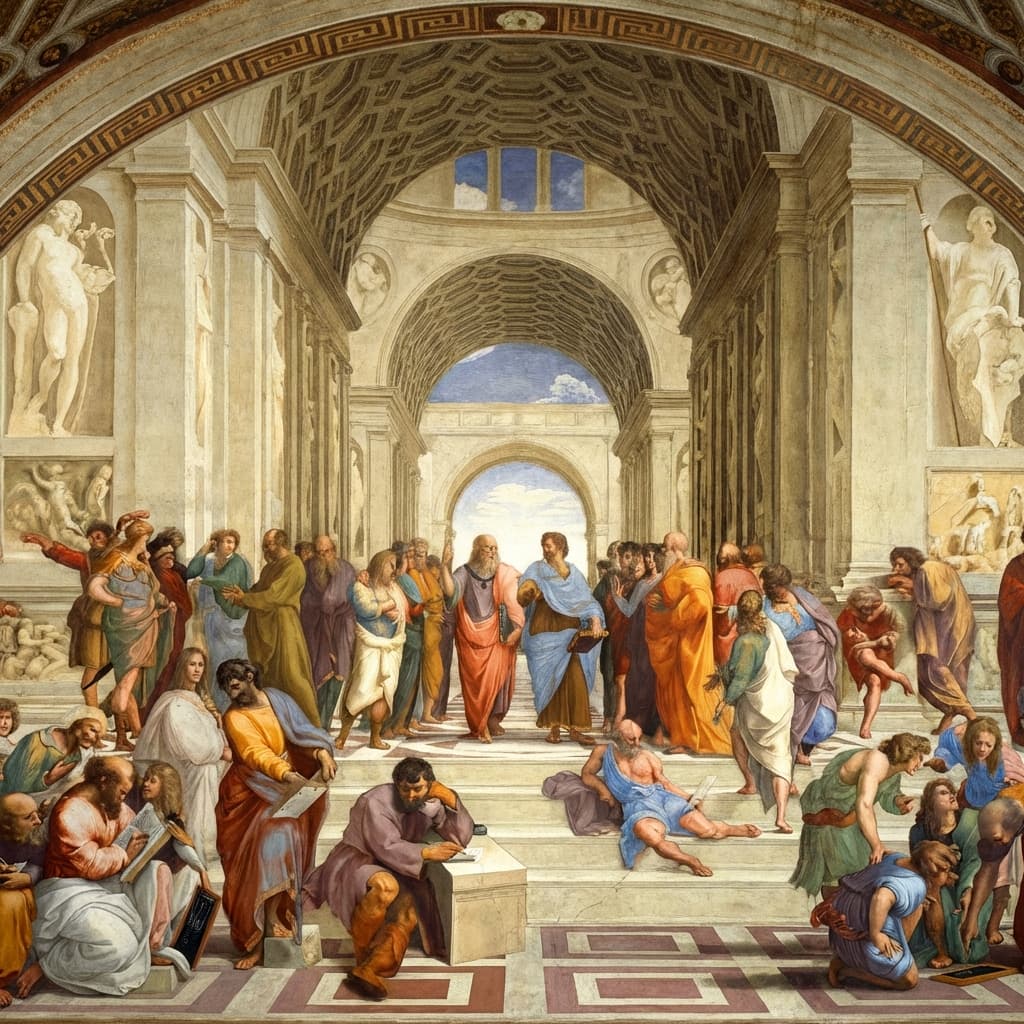
The Renaissance, meaning "rebirth" in French, is the foundational period of Western art as we understand it today. Beginning in Florence in the early 1400s, it represented a dramatic shift in how artists depicted the world, drawing on the rediscovered knowledge of classical Greece and Rome to develop new techniques for creating the illusion of three-dimensional space on a flat surface. The invention of linear perspective, pioneered by Filippo Brunelleschi and codified by Leon Battista Alberti, gave painters mathematical tools for constructing convincing spatial depth, transforming the flat, symbolic imagery of medieval art into lifelike scenes.
The Early Renaissance in Florence produced masters like Sandro Botticelli, whose "Birth of Venus" embodies the era's fusion of classical mythology and Christian thought, and Masaccio, whose frescoes in the Brancacci Chapel demonstrate the revolutionary power of perspective and naturalistic modeling. The High Renaissance, spanning roughly 1490 to 1527, is defined by three towering figures: Leonardo da Vinci, Michelangelo, and Raphael. Leonardo's "Mona Lisa" and "The Last Supper" set new standards for psychological depth and compositional sophistication. Michelangelo's Sistine Chapel ceiling remains one of the supreme achievements of human artistic endeavor, while Raphael's harmonious compositions epitomize the Renaissance ideal of balanced perfection.
The Renaissance also transformed the social status of artists, elevating them from anonymous craftsmen to celebrated creative geniuses. This shift, combined with the patronage of wealthy families like the Medici, established the model of artist-patron relationships that continues to shape the art market today.
Why Does It Matter for Collectors?
Authentic Renaissance paintings by major masters are almost exclusively in museum collections, and the rare appearances at market generate extraordinary prices and international attention. However, the broader Renaissance market includes works by accomplished but less famous artists, decorative objects, manuscript pages, and period prints that offer genuine collecting opportunities.
Renaissance drawings appear at auction more frequently than paintings and can represent remarkable value, offering direct insight into the creative process of major artists. Old Master print collecting, including engravings and woodcuts by Albrecht Durer and others, is a well-established field with extensive scholarship. For any Renaissance acquisition, expert authentication and condition assessment are essential, and collectors should work with specialists who have deep knowledge of the period.
Related Terms
Visual representation of Renaissance