Futurism
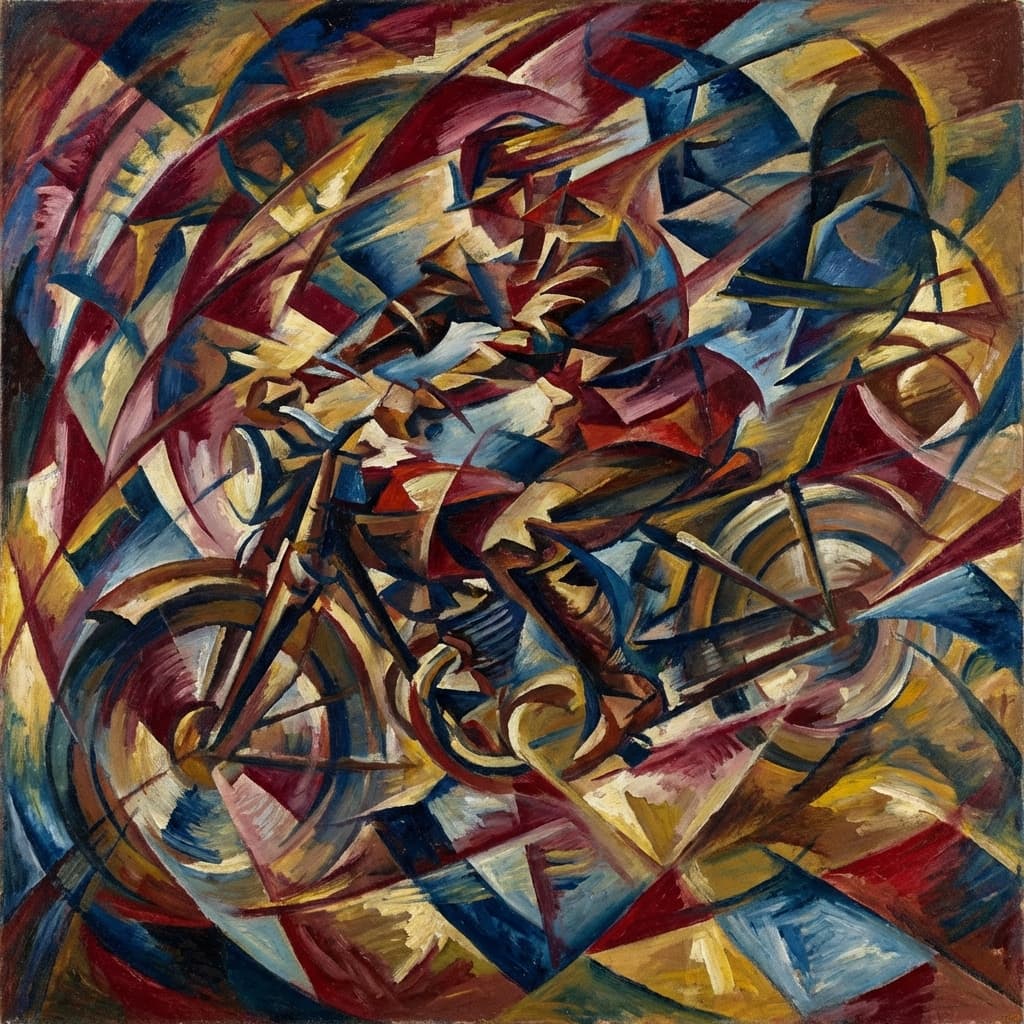
An Italian art movement founded in 1909 that celebrated speed, technology, youth, and modernity, seeking to capture the dynamism and energy of the machine age in visual art.
What Is Futurism?
Futurism burst onto the cultural scene in 1909 when the Italian poet Filippo Tommaso Marinetti published his "Manifesto of Futurism" on the front page of the French newspaper Le Figaro. Marinetti declared that a roaring automobile was more beautiful than the Victory of Samothrace, and called for an art that embraced speed, machinery, violence, and the destruction of traditional cultural institutions. The manifesto was deliberately provocative, and it launched a movement that would reshape Italian art and influence avant-garde practice across Europe.
In painting and sculpture, the key Futurist artists were Umberto Boccioni, Giacomo Balla, Carlo Carra, Gino Severini, and Luigi Russolo. They borrowed the fragmented planes and multiple perspectives of Cubism but infused them with kinetic energy, seeking to represent motion, speed, and the passage of time on a static surface. Boccioni's sculpture "Unique Forms of Continuity in Space" captures a striding figure in aerodynamic bronze forms that seem to cut through air, and it remains the movement's most iconic three-dimensional work. Balla's "Dynamism of a Dog on a Leash" uses repetition of forms to suggest movement, anticipating techniques that would later appear in photography and animation.
Futurism extended beyond visual art into literature, music, theater, fashion, and even cooking. The movement's ambitions were totalizing: Futurists wanted to remake every aspect of culture and society along modern, dynamic lines. However, the movement's association with Italian Fascism during the 1920s and 1930s has complicated its legacy, and this political dimension is an important context for understanding and collecting Futurist work.
Why Does It Matter for Collectors?
Futurist paintings and sculptures by major artists are rare on the market and command high prices when they appear. Boccioni died young in 1916, making his works especially scarce. However, Futurist prints, drawings, and publications are more accessible and represent a fascinating area of collecting. The original manifestos and Futurist books, with their radical typography and design, are collected as both historical documents and works of art.
Collectors should be aware of the movement's political complexities, as the relationship between Futurism and Fascism is a subject of ongoing scholarly discussion. When evaluating works, authenticity is critical, and consultation with specialists in Italian early modern art is advisable. The Futurist legacy in graphic design and typography has experienced renewed appreciation, making works from this area particularly interesting for design-oriented collectors.
Related Terms
Visual representation of Futurism