Cubism
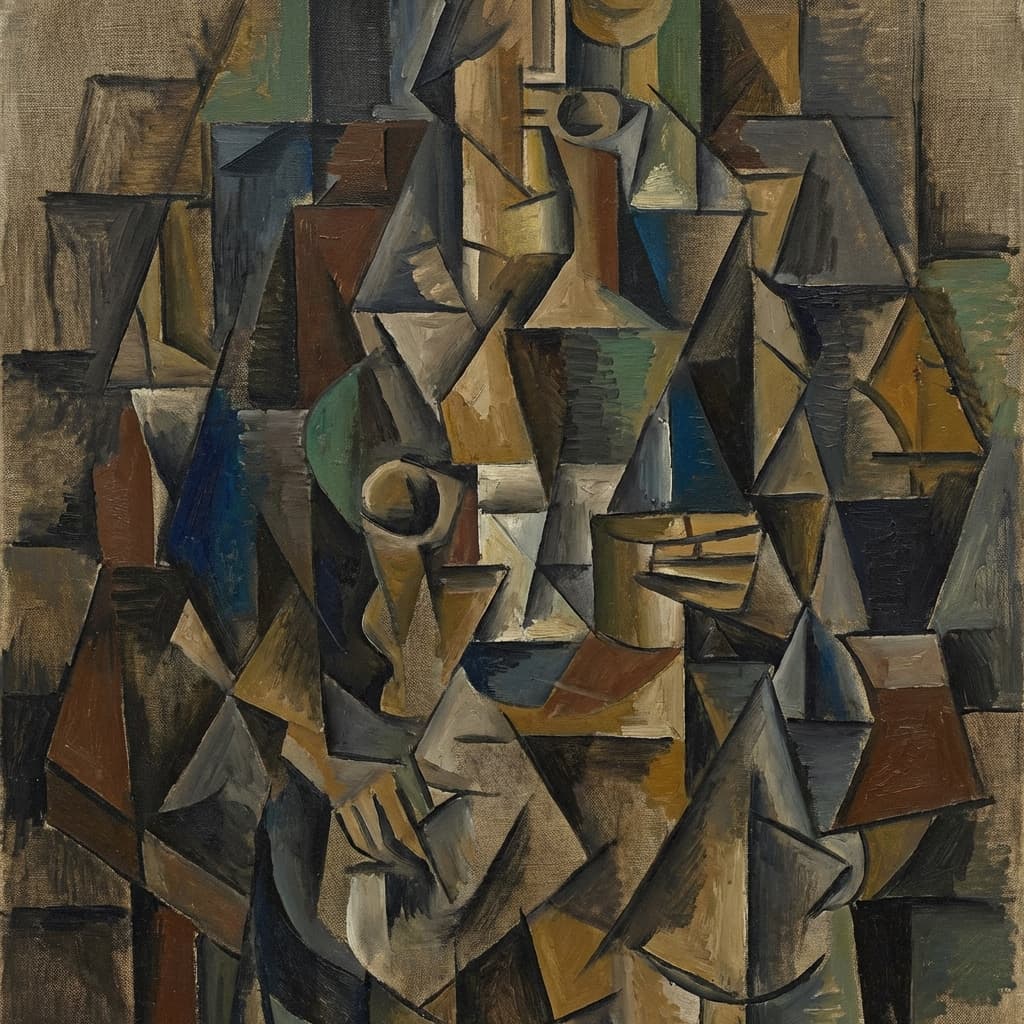
A revolutionary early 20th-century art movement pioneered by Pablo Picasso and Georges Braque, characterized by the fragmentation of objects into geometric forms and the depiction of multiple perspectives simultaneously.
What Is Cubism?
Cubism is widely considered the most influential art movement of the twentieth century. Developed between 1907 and 1914 by Pablo Picasso and Georges Braque, it fundamentally changed how artists represent space, form, and perspective. Rather than depicting objects from a single fixed viewpoint, Cubist artists broke their subjects into geometric fragments and reassembled them to show multiple angles simultaneously on a flat canvas. The result was a radical departure from the tradition of illusionistic representation that had dominated Western art since the Renaissance.
Art historians typically divide Cubism into two phases. Analytic Cubism, spanning roughly 1909 to 1912, involved the systematic deconstruction of objects into interlocking planes rendered in muted, nearly monochromatic palettes of browns, grays, and ochres. Picasso's "Portrait of Daniel-Henry Kahnweiler" exemplifies this approach. Synthetic Cubism, which followed from around 1912 to 1914, introduced brighter colors, simpler shapes, and the groundbreaking technique of collage, where artists incorporated real-world materials like newspaper clippings and wallpaper directly onto the canvas. Braque's "Fruit Dish and Glass" is a landmark of this phase.
The influence of Cubism extended far beyond Picasso and Braque. Artists such as Juan Gris, Fernand Leger, and Robert Delaunay developed their own distinctive Cubist vocabularies. The movement's ideas about multiple perspectives, geometric abstraction, and the integration of everyday materials into art laid the groundwork for virtually every major movement that followed, from Futurism and Constructivism to Abstract Expressionism and Pop Art.
Why Does It Matter for Collectors?
Works by Picasso and Braque from the Cubist period are among the most valuable in the art market, routinely achieving prices in the tens of millions at auction. However, the broader Cubist movement offers collecting opportunities at many price levels. Prints and works on paper by major Cubist artists are more accessible than paintings, and works by second-generation Cubists such as Albert Gleizes and Jean Metzinger can be acquired for significantly less while still representing genuine artistic achievement.
When evaluating Cubist works, authenticity is paramount. The market for Picasso in particular has attracted sophisticated forgeries, making provenance documentation and expert authentication essential. Collectors should also consider the period in which a work was created, as pieces from the core Analytic and Synthetic Cubist years tend to hold the greatest art-historical significance.
Related Terms
Visual representation of Cubism