Collage
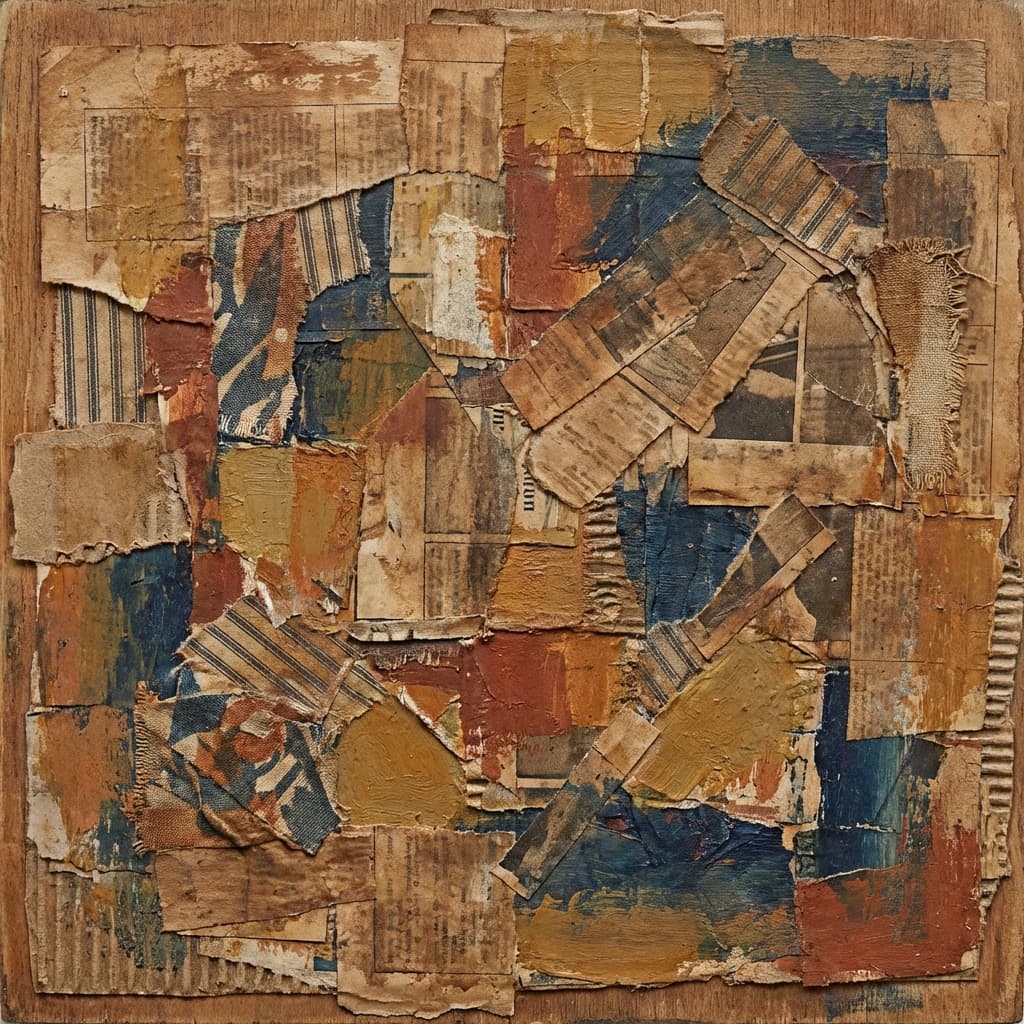
An artistic technique in which various materials such as paper, fabric, photographs, and found objects are assembled and adhered to a support surface to create a unified composition.
What Is Collage?
Collage, derived from the French word "coller" meaning to glue, is a technique in which artists compose works by attaching various materials to a flat surface. The materials can include cut or torn paper, newspaper clippings, photographs, fabric, string, wood, metal, and virtually any other material that can be affixed to a support. Collage fundamentally challenged the idea that art must be created solely through traditional drawing and painting techniques, opening the door to an entirely new relationship between art and the material world.
The technique entered the fine art vocabulary through Cubism. In 1912, Pablo Picasso created "Still Life with Chair Caning," incorporating a piece of oilcloth printed with a chair-caning pattern into a painted composition, and Georges Braque began gluing pieces of wallpaper and newspaper into his works. These papiers colles, or pasted papers, represented a revolutionary step in the development of modern art by introducing real-world materials into the previously self-contained world of painting. The Dadaists, particularly Hannah Hoch and Kurt Schwitters, expanded the possibilities of collage dramatically, using the technique for social commentary, visual poetry, and pure aesthetic experimentation.
Throughout the twentieth century, collage became an essential technique for artists across movements. Henri Matisse's late paper cut-outs, which he called "painting with scissors," produced some of the most joyful and visually striking works of his career. Robert Rauschenberg's combines merged painting with found objects and images in works that blurred the boundaries between painting and sculpture. Contemporary artists like Wangechi Mutu and Mark Bradford continue to explore collage as a primary medium, using the technique's inherent layering and juxtaposition to address themes of identity, history, and transformation.
Why Does It Matter for Collectors?
Collage presents unique considerations for collectors. Because collages incorporate diverse materials, each with different aging properties, conservation can be more complex than for works in a single medium. Paper may yellow or become brittle, adhesives may fail, and found materials may deteriorate in unpredictable ways. When evaluating a collage for purchase, examine the condition of all component materials carefully and ask about the adhesives and techniques used.
Despite these conservation challenges, collage offers rich collecting opportunities. The technique is used by artists at every career stage and price level, and the tactile, layered quality of well-made collages gives them a physical presence that reproductions cannot capture. Works by major collagists like Schwitters and Rauschenberg are museum-level acquisitions, but contemporary collage artists offer excellent work at accessible prices.
Related Terms
Visual representation of Collage