Art Nouveau
An international style of art, architecture, and decorative arts popular from the 1890s to 1910, characterized by organic, flowing lines inspired by natural forms such as plants, flowers, and curves.
What Is Art Nouveau?
Art Nouveau, meaning "new art" in French, was an international movement that flourished from roughly 1890 to 1910. It represented a deliberate break from the historicist styles that had dominated the nineteenth century, seeking instead to create an entirely new aesthetic vocabulary drawn from the natural world. The hallmarks of Art Nouveau are sinuous, whiplash curves, floral and botanical motifs, and an emphasis on craftsmanship that dissolved the boundaries between fine art and applied design.
The movement appeared across Europe under different names: Jugendstil in Germany, Stile Liberty in Italy, Modernisme in Catalonia, and Sezessionstil in Austria. Major figures include Alphonse Mucha, whose theatrical posters and decorative panels defined the graphic side of the movement, and Gustav Klimt, whose paintings like "The Kiss" fused ornamental pattern with figurative imagery. In architecture, Antoni Gaudi's buildings in Barcelona, particularly the Sagrada Familia and Casa Batllo, pushed the organic principles of Art Nouveau to extraordinary extremes. Rene Lalique and Louis Comfort Tiffany brought the style into the decorative arts through innovative glasswork and jewelry that remain benchmarks of the form.
Art Nouveau emerged partly as a reaction against industrialization, championing the idea that beauty should infuse everyday life. Artists and designers worked across disciplines, creating complete environments where furniture, wallpaper, lighting, and architecture harmonized into unified aesthetic experiences. This "total work of art" philosophy made Art Nouveau one of the first truly interdisciplinary modern movements.
Why Does It Matter for Collectors?
Art Nouveau occupies a unique position in the collecting world because it spans fine art, decorative arts, and design. This breadth means collectors can build focused collections around specific media, from Mucha lithographs and Tiffany lamps to Lalique glass and period furniture. The market is mature and well documented, with extensive scholarship and auction records providing reliable price benchmarks.
Original Art Nouveau works in good condition are increasingly scarce, which has driven steady price appreciation over the past several decades. Prints and posters by Mucha remain among the most popular entry points, with prices ranging from a few hundred dollars for later reproductions to tens of thousands for rare original lithographs. When collecting, pay close attention to condition, as the organic forms and delicate materials characteristic of the period can be vulnerable to damage and difficult to restore authentically.
Related Terms
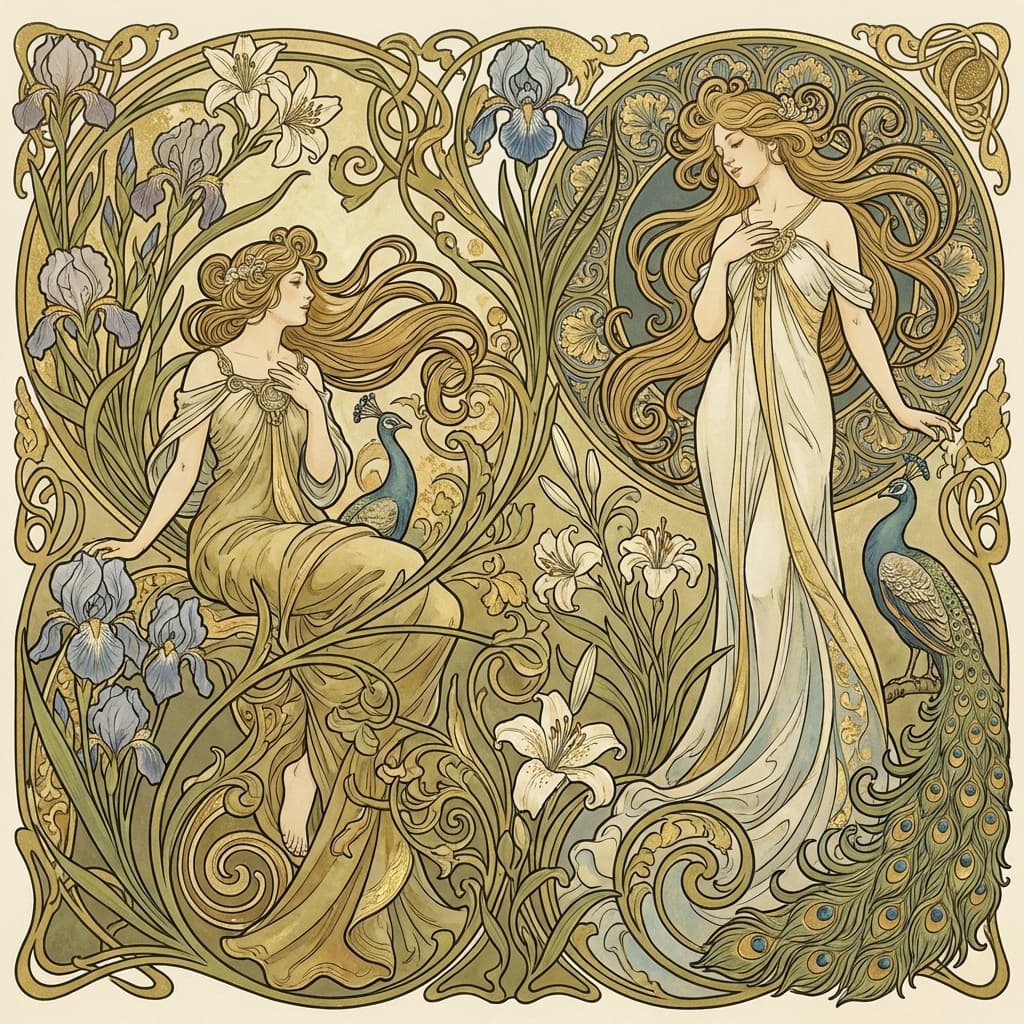
Visual representation of Art Nouveau